Jamie Oliver Christmas gravy is the rich, glossy sauce that ties a holiday plate together. It tastes deeply savory, with a gentle sweetness from apple juice and a soft herbal note from thyme and rosemary, and it finishes silky enough to coat the back of a spoon. This version is inspired by Jamie Oliver’s approach to holiday cooking, built on roasted root vegetables and a simple butter-and-flour thickener instead of a long reduction.
It takes 60 minutes from start to finish, and most of that time is hands-off simmering while you deal with everything else in the kitchen. I’d call it an easy, forgiving project — a good fit for Thanksgiving or Christmas dinner, a Sunday roast, or a potluck where you need something that reheats well and holds its texture.
What Is Jamie Oliver Christmas Gravy?
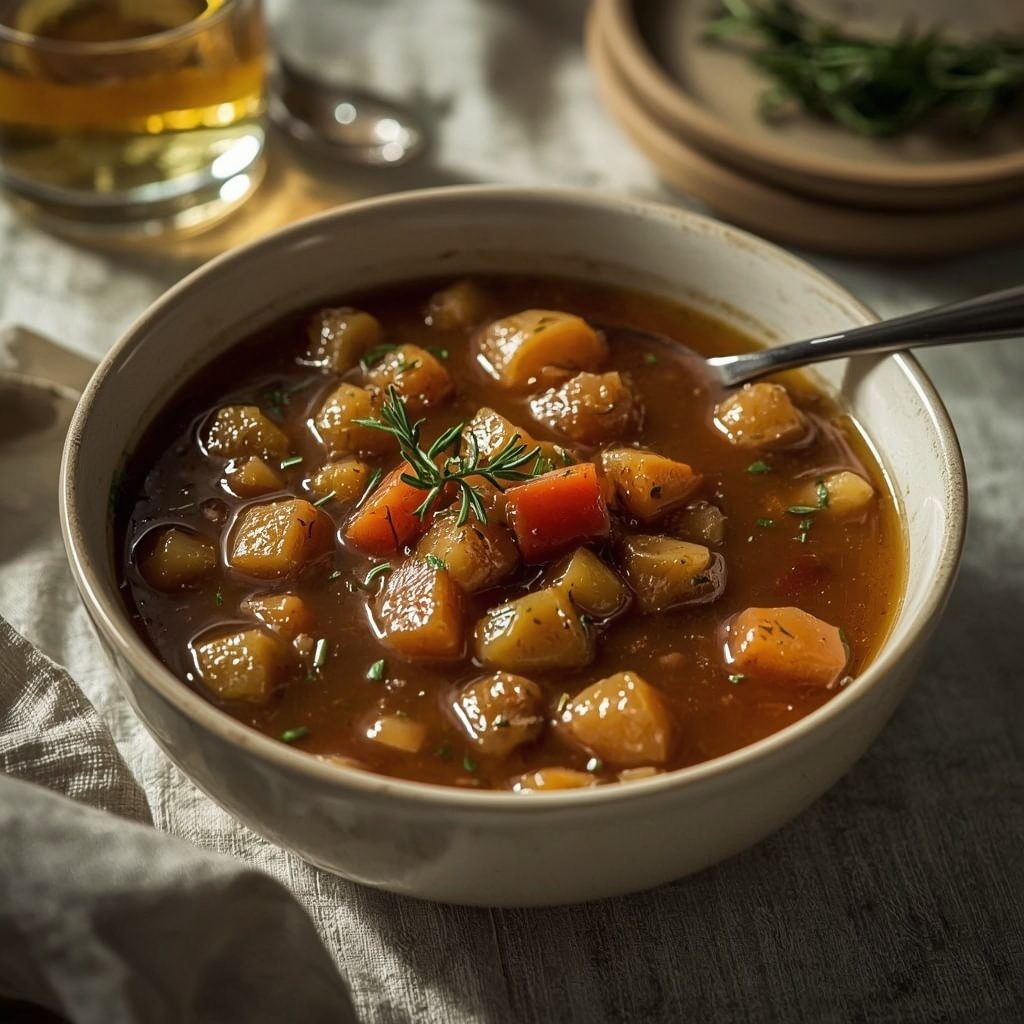
Gravy is the sauce poured over roast meat and potatoes at a British holiday table, and the best versions are made by building flavor from vegetables before thickening. This one simmers onion, carrot, celery, parsnip, garlic and herbs in broth and apple juice until the liquid reduces and the vegetables turn very soft, then strains it all away.
What makes this version different is the finishing step: a beurre manié, which is just softened butter mashed with flour. Whisked in at the end, it thickens the gravy in a few minutes and gives it a glossy finish without the risk of lumps you get from sprinkling flour straight into hot liquid.
Gather These Fresh Ingredients for Jamie Oliver Christmas Gravy
This makes about 3 cups of finished gravy, enough for 8 servings. Set everything out before you start the pan — the vegetables go in all at once.
Vegetables
- 1 large yellow onion — roughly chopped; the size doesn’t matter much since it gets strained out.
- 2 medium carrots — peeled and roughly chopped, for sweetness and color.
- 2 celery stalks — roughly chopped, including the leaves if they’re there.
- 1 medium parsnip — peeled and roughly chopped; it brings a nutty sweetness that makes this gravy taste like the holidays.
- 4 garlic cloves — smashed, not chopped, so they release flavor without burning.
Herbs and Seasonings
- 2 sprigs fresh thyme
- 2 sprigs fresh rosemary
- 1 dried bay leaf
- 1 teaspoon kosher salt — start here, then taste at the end, since broth brands vary a lot in saltiness.
- 1/2 teaspoon freshly ground black pepper
Liquids and Sauces
- 4 cups (960ml) low-sodium chicken broth — low-sodium matters, because the gravy reduces and concentrates the salt.
- 1 cup (240ml) unsweetened apple juice — use unsweetened apple juice, not a sweetened blend, or the gravy turns out too sweet.
- 1 tablespoon (15ml) Dijon mustard — it doesn’t read as mustard in the finished sauce, just as depth.
- 1 tablespoon (15ml) soy sauce — optional, but it adds a savory backbone if your broth is on the mild side.
Thickener
- 3 tablespoons (42g) unsalted butter — softened, so it mashes smoothly into the flour.
- 3 tablespoons (23g) all-purpose flour
- 2 tablespoons (30ml) olive oil — for the pan; feel free to use a neutral oil instead.
Useful Equipment
Nothing here is specialty gear — a couple of good pans and a fine sieve will do it.
- Large saucepan — a heavy 4-quart (3.8L) pan with a lid gives the most even browning.
- Fine-mesh sieve — a strainer lined with a double layer of cheesecloth works if yours is coarse.
- Whisk — for incorporating the butter-flour paste without lumps.
- Small bowl — for mashing the beurre manié.
- Clean saucepan — a second pan means you can strain without scrambling for a vessel.
- Gravy boat — warm it with hot water first, then dry it, so the gravy stays hot at the table.
Detailed Step-by-Step Instructions to Make Jamie Oliver Christmas Gravy
Step 1: Brown the Vegetables
Heat 2 tablespoons (30ml) olive oil in a large saucepan over medium-high heat until it shimmers. Add the chopped onion, carrots, celery and parsnip and cook, stirring occasionally, for 8 to 10 minutes. You want the vegetables softened and lightly browned at the edges — those browned spots are where a lot of the gravy’s color and flavor come from.
Step 2: Add the Aromatics
Stir in the 4 smashed garlic cloves, 2 thyme sprigs, 2 rosemary sprigs and the bay leaf, and cook for 1 minute, just until fragrant. Keep the garlic moving in the pan. If it scorches, it turns the whole gravy bitter, and no amount of seasoning fixes that.
Step 3: Simmer the Broth
Pour in 4 cups (960ml) chicken broth and 1 cup (240ml) unsweetened apple juice, then stir in 1 tablespoon (15ml) Dijon mustard, 1 teaspoon salt and 1/2 teaspoon black pepper. Bring it to a boil, drop the heat to low, and simmer uncovered for 25 to 30 minutes. The liquid should fall by about one-third and the vegetables should be very tender when you press one against the side of the pan.
Step 4: Make the Beurre Manié
While the broth simmers, mash 3 tablespoons (42g) softened butter with 3 tablespoons (23g) all-purpose flour in a small bowl until you have a smooth paste. Think of this paste as the glue that gives the gravy its body — it needs to be lump-free before it ever touches the hot liquid. Set it aside near the stove.
Step 5: Strain the Broth
Set a fine-mesh sieve over a clean saucepan and pour the broth through it, pressing on the solids with the back of a spoon to squeeze out every drop. Discard the solids. You should end up with about 3 cups (720ml) of strained broth — if you’re short, top it up with a splash of chicken broth.
Step 6: Thicken the Gravy
Bring the strained broth back to a simmer over medium heat. Whisk in the beurre manié a little at a time, whisking constantly so it dissolves evenly, then simmer for 3 to 5 minutes. The gravy is ready when it thickens enough to coat the back of a spoon and a line drawn through it with your finger holds its shape.
Step 7: Season and Adjust
Stir in 1 tablespoon (15ml) soy sauce if you’re using it, then taste and add more salt and pepper as needed. If the gravy seems too thick, thin it with a splash of chicken broth or water and whisk again — it should pour easily but not run off the plate like water.
Step 8: Serve Hot
Pour the gravy into a warm gravy boat and serve it hot, alongside the turkey and mashed potatoes. Give it a quick whisk right before pouring, since it can form a thin skin as it sits.
Common Mistakes and How I Fixed Them
The first time I made this, I let the garlic go dark while I was distracted by the turkey, and the finished gravy had a sharp, bitter edge I couldn’t cover up. My other early slip was adding the butter-flour paste in one lump — it seized into little clumps that never fully dissolved. Both problems are easy to avoid once you know what to watch for.
- Garlic left too long — burnt garlic tastes harsh no matter how much salt you add, so pull the pan off the heat for a moment if you need to.
- Paste added all at once — whisk it in a spoonful at a time over a steady simmer, and any small lumps will work themselves out.
- Skipping the taste test — broth and apple juice vary in salt and sweetness, so always adjust at the end instead of trusting the written amounts.
- Straining without pressing — press the vegetables firmly against the sieve or you leave behind the best, most concentrated flavor.
What Pairs Perfectly with Christmas Gravy
- Classic mashed potatoes — plenty of butter and a little warm milk give the gravy something to soak into.
- Roast turkey or chicken — the obvious partner; spoon it over sliced meat and let it pool slightly.
- Herb stuffing — a scoop of stuffing with gravy poured over the top is the best bite on the plate.
- Crisp green salad — a sharp, lemony salad cuts through the richness of the meal nicely.
- Warm dinner rolls — tear one open and dip it, which is what everyone does at the counter anyway.
Pro Tips for Making Christmas Gravy
- Color the vegetables well — a few deeper brown spots on the onion and parsnip give the gravy a richer shade without any browning sauce.
- Keep it warm — hold the gravy over the lowest heat, whisking now and then, rather than letting it cool and reheating twice.
- Taste with the meat — a spoonful of gravy alone tastes stronger than it will over turkey, so season slightly boldly.
- Use unsweetened apple juice — a sweetened juice pushes the gravy toward dessert, and there’s no easy way to correct it.
- Strain into a warm pan — a cold saucepan drops the temperature and makes the butter paste harder to incorporate.
- Whisk before serving — thirty seconds with a whisk restores the glossy surface if the gravy has been sitting.
Inspiring Variations of Christmas Gravy
- Mushroom depth — add 8 ounces (225g) sliced cremini mushrooms with the onion for a meatier, earthier gravy.
- Fresh sage twist — swap the rosemary for 3 fresh sage leaves, which suits turkey and stuffing especially well.
- Extra apple note — stir in 2 tablespoons (30ml) of apple butter at the end for a rounder sweetness.
- Peppery finish — add an extra 1/2 teaspoon coarse black pepper after thickening for a gravy with a little bite.
- Herb-forward version — tie 4 extra thyme sprigs into a bundle and simmer them with the broth for a stronger herbal note.
How to Store Christmas Gravy Properly
- Cool it fast — spread the gravy in a shallow container so it drops out of the danger zone quickly, then cover.
- Fridge for days — keep it in an airtight container for up to 3 days and reheat only what you plan to use.
- Freezer for months — freeze in a freezer-safe container for up to 2 months, leaving an inch of headspace for expansion.
- Thaw overnight — move it to the refrigerator the night before, then whisk gently as it warms to bring the texture back.
Smart Reheating Tips for Christmas Gravy
- Stovetop is best — warm it over low heat for 5 to 7 minutes, whisking often, until it reaches 165°F (74°C) in the center.
- Loosen with broth — add a splash of chicken broth or water if it has thickened too much in the fridge.
- Microwave in short bursts — heat in 30-second intervals, stirring between each, until it’s steaming and reaches 165°F (74°C).
- Skip the oven — direct heat in a pan gives you the control you need to keep the gravy smooth and glossy.
Nutritional Value
These values are estimates per serving, based on 8 servings.
| Nutrient | Amount |
|---|---|
| Calories | 99 kcal |
| Protein | 2g |
| Carbs | 10g |
| Fat | 6g |
| Fiber | 2g |
| Sodium | 520mg |
FAQs
Can I make Jamie Oliver Christmas gravy recipe ahead of time?
Yes — prepare it through step 5 up to 2 days in advance and refrigerate the strained broth. Finish with the beurre manié just before serving so the texture stays silky.
Can I use a different liquid instead of apple juice?
White grape juice or a splash of apple juice plus 1 tablespoon of lemon juice both work in the same amount. Avoid anything sweetened, since the gravy reduces and the sugar concentrates.
How do I know when the gravy is thick enough?
Dip a spoon in and draw your finger across the back — the line should hold cleanly. If it fills back in immediately, simmer another minute or two.
Why is my gravy lumpy?
Usually the butter-flour paste went in too fast or the liquid was boiling too hard. Whisk in a spoonful at a time over a gentle simmer, and strain once more if lumps persist.
Can I make this gravy without the soy sauce?
Absolutely — it’s optional and only there for extra depth. Taste after thickening and add a pinch more salt if the flavor feels flat without it.
PrintJamie Oliver-Inspired Christmas Gravy

A rich, glossy gravy inspired by Jamie Oliver’s approach to holiday cooking, made with roasted root vegetables, fresh herbs, and a splash of apple cider for a touch of sweetness. It is deeply savory, silky, and perfect for spooning over roast turkey, mashed potatoes, and stuffing.
- Prep Time: 15
- Cook Time: 45
- Total Time: 60
- Yield: 8 1x
- Category: Side Dish
- Method: Stovetop
- Cuisine: American
Ingredients
- 2 tablespoons (30ml) olive oil
- 1 large yellow onion, roughly chopped
- 2 medium carrots, peeled and roughly chopped
- 2 celery stalks, roughly chopped
- 1 medium parsnip, peeled and roughly chopped
- 4 garlic cloves, smashed
- 2 sprigs fresh thyme
- 2 sprigs fresh rosemary
- 1 dried bay leaf
- 4 cups (960ml) low-sodium chicken broth
- 1 cup (240ml) apple cider
- 1 tablespoon (15ml) Dijon mustard
- 1 teaspoon kosher salt
- 1/2 teaspoon freshly ground black pepper
- 3 tablespoons (42g) unsalted butter, softened
- 3 tablespoons (23g) all-purpose flour
- 1 tablespoon (15ml) soy sauce (optional, for depth)
Instructions
- Heat the olive oil in a large saucepan over medium-high heat until shimmering. Add the onion, carrots, celery, and parsnip and cook, stirring occasionally, for 8 to 10 minutes, until the vegetables are softened and lightly browned at the edges.
- Stir in the garlic, thyme, rosemary, and bay leaf and cook for 1 minute, until fragrant. Do not let the garlic burn or it will turn the gravy bitter.
- Pour in the chicken broth and apple cider, then stir in the Dijon mustard, salt, and pepper. Bring to a boil, then reduce the heat to low and simmer, uncovered, for 25 to 30 minutes, until the liquid has reduced by about one-third and the vegetables are very tender.
- While the broth simmers, mash the softened butter with the flour in a small bowl until smooth to make a beurre manié. Set aside.
- Strain the broth through a fine-mesh sieve into a clean saucepan, pressing on the solids with a spoon to extract as much liquid as possible; discard the solids. You should have about 3 cups (720ml) of strained broth.
- Bring the strained broth to a simmer over medium heat. Whisk in the beurre manié a little at a time, whisking constantly, and simmer for 3 to 5 minutes, until the gravy thickens enough to coat the back of a spoon.
- Stir in the soy sauce, if using, and taste for seasoning, adding more salt and pepper if needed. If the gravy seems too thick, thin it with a splash of chicken broth or water.
- Pour into a warm gravy boat and serve hot.
Notes
Store leftover gravy in an airtight container in the refrigerator for up to 3 days. To freeze, cool completely and transfer to a freezer-safe container; freeze for up to 2 months. Thaw overnight in the refrigerator, then reheat gently in a saucepan over low heat, whisking often and adding a splash of broth or water if it thickens too much. Make ahead: prepare through step 5 up to 2 days in advance, refrigerate the strained broth, and finish with the beurre manié just before serving.
Nutrition
- Calories: 99
- Sugar: 6g
- Sodium: 520mg
- Saturated Fat: 3g
- Carbohydrates: 10g
- Fiber: 2g
- Protein: 2g
- Cholesterol: 11mg
Keywords: Christmas gravy, Jamie Oliver gravy, homemade gravy, turkey gravy, holiday gravy, root vegetable gravy, apple cider gravy, easy Christmas recipe, stovetop gravy, Thanksgiving gravy