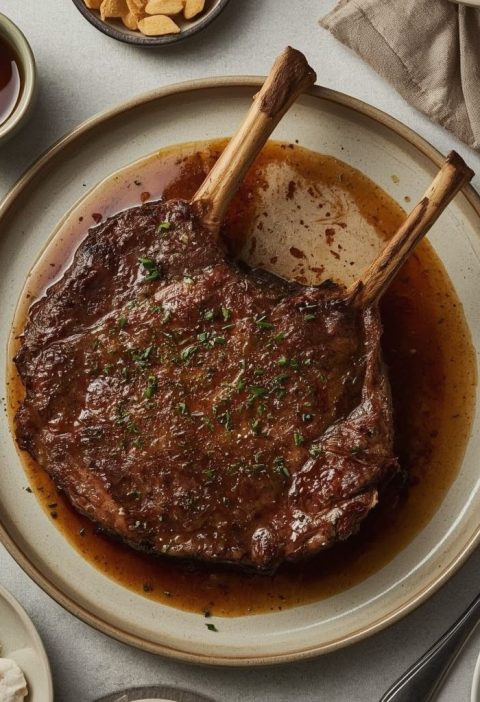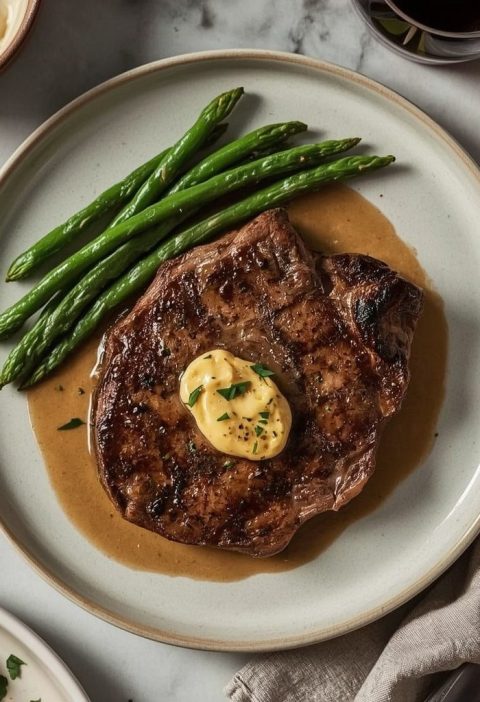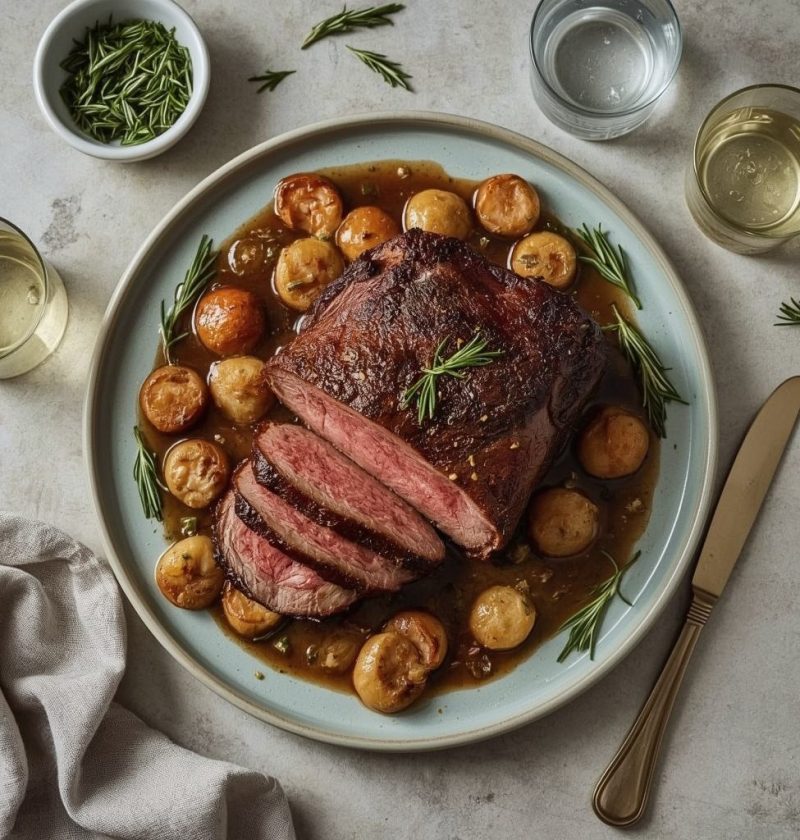
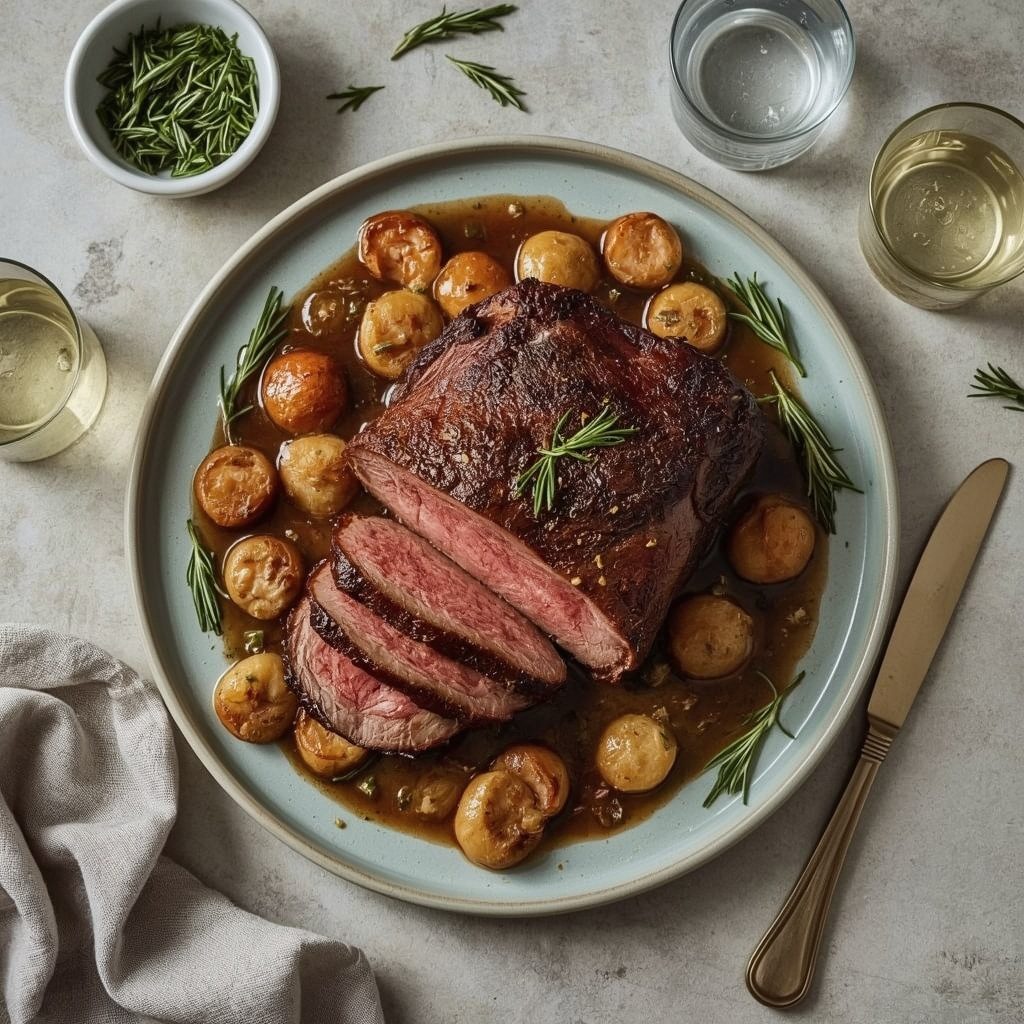
Jamie Oliver Christmas roast beef is the centerpiece I turn to when the table needs something generous but the cook needs to stay calm. A paste of garlic, rosemary, thyme and Dijon goes onto the beef, then a hot oven builds a deep brown crust before the temperature drops for a gentle finish. The meat comes out rosy in the middle, tender enough to cut with a butter knife, and the pan juices turn into a glossy gravy. This version is inspired by Jamie Oliver’s no-fuss approach rather than a copy of his exact method.
From start to finish you need about 115 minutes, with only 20 minutes of hands-on prep. The steps are simple: rub, roast, rest, whisk the gravy. It fits a holiday table, a weekend gathering or a potluck where you want to bring the main dish and impress without stress.
What Is Jamie Oliver Christmas Roast Beef?
Roast beef is a British holiday staple, and a ribeye roast is one of the classic cuts for it. The meat comes from the rib section, which has good marbling and a rich flavor that holds up to high heat. Tying the roast keeps it compact so it cooks evenly from edge to center.
The version here keeps the spirit of simple British roasting: a herb and mustard crust, a hot start, a low finish, and a gravy built from the pan. The vegetables underneath act as a rack and a flavor base, so nothing goes to waste.
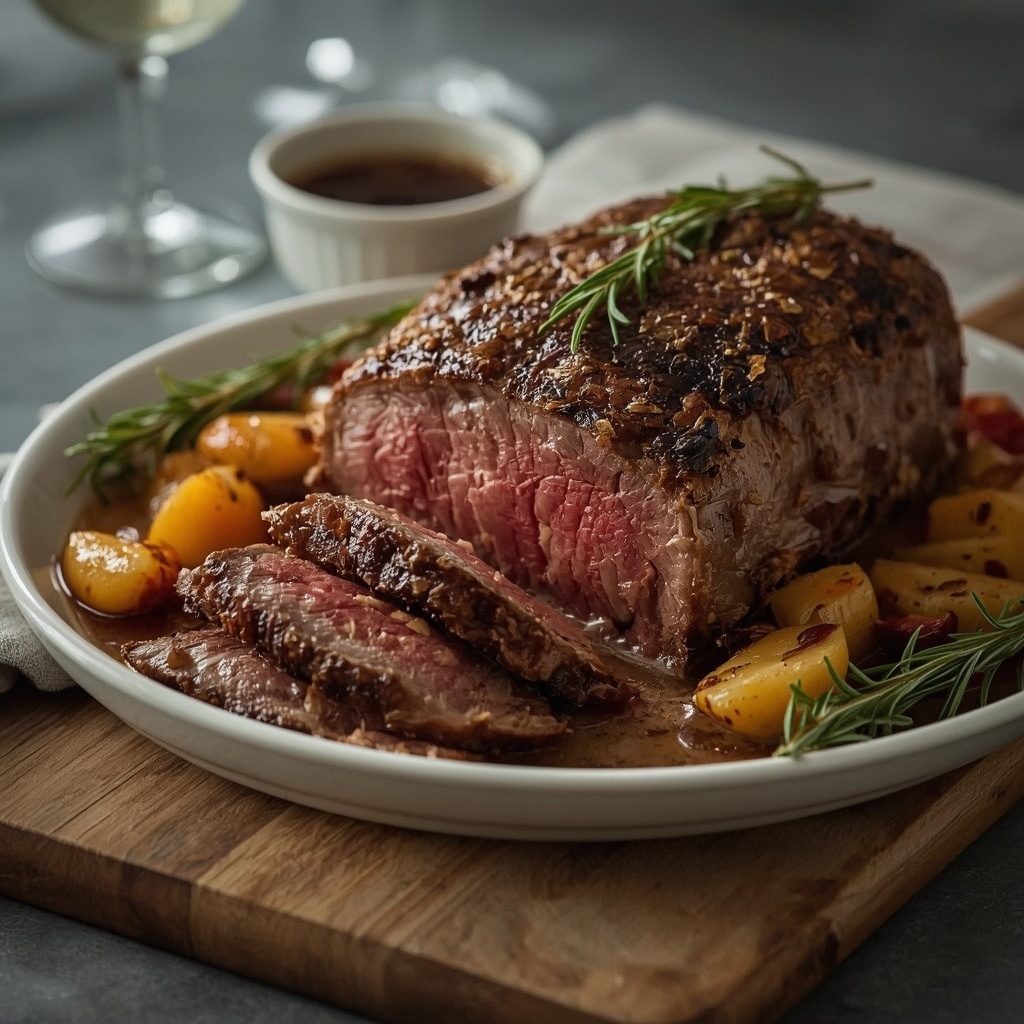
Gather These Fresh Ingredients for Jamie Oliver Christmas Roast Beef
Everything here is easy to find at a regular grocery store. Use the amounts below exactly, and let the beef sit out before you start.
The Beef and Base
- 1 (4-pound / 1.8kg) boneless beef ribeye roast — tied with kitchen twine and at room temperature for 45 minutes, so it roasts evenly.
- 1 large yellow onion — halved and thickly sliced; it sweetens the pan juices.
- 2 medium carrots — cut into 2-inch chunks, they act as part of the rack.
- 2 celery stalks — cut into 2-inch chunks.
- 2 tablespoons (30ml) olive oil — helps the paste cling to the meat.
The Herbed Crust
- 1 tablespoon (15g) Dijon mustard — adds tang and helps the herbs stick.
- 4 garlic cloves — finely grated or minced.
- 2 tablespoons finely chopped fresh rosemary — from about 2 sprigs, chopped fine so it doesn’t burn.
- 1 tablespoon fresh thyme leaves — stripped from the stems.
Seasonings
- 2 teaspoons kosher salt — for the crust paste.
- 1 teaspoon freshly ground black pepper — for the crust paste.
- 1/2 teaspoon kosher salt — or to taste for the gravy.
- 1/4 teaspoon freshly ground black pepper — or to taste for the gravy.
For the Gravy
- 1 cup (240ml) low-sodium beef broth — low-sodium so you can season the gravy yourself.
- 1 tablespoon Worcestershire sauce — deepens the savory flavor.
- 1 tablespoon all-purpose flour — thickens the gravy.
- 1/4 cup (60ml) cold water — whisked with the flour into a smooth slurry.
Useful Equipment
You don’t need much, but a few tools make the job much easier.
- Roasting pan — a 9×13-inch (23x33cm) pan or a heavy roasting pan just large enough for the beef.
- Instant-read thermometer — the only reliable way to hit your doneness.
- Carving board — with a channel to catch juices, if you have one.
- Fine-mesh sieve — for straining the pan liquid into the saucepan.
- Small saucepan — for finishing the gravy on the stovetop.
- Whisk or small jar — for mixing the flour slurry without lumps.
Detailed Step-by-Step Instructions to Make Jamie Oliver Christmas Roast Beef
Step 1: Dry and Preheat
Take the beef out of the refrigerator 45 minutes before roasting and pat it completely dry with paper towels. Dry meat is the secret to a crisp, browned crust, so don’t skip this. Position a rack in the lower third of the oven and preheat to 450°F (230°C).
Step 2: Make the Herb Paste
In a small bowl, stir together the olive oil, 2 teaspoons kosher salt, 1 teaspoon black pepper, Dijon mustard, garlic, rosemary and thyme into a thick paste. Rub it all over the beef, covering the top, sides and ends. If the paste slides off, pat the meat dry again before rubbing.
Step 3: Build the Vegetable Rack
Scatter the onion, carrots and celery in the bottom of a 9×13-inch (23x33cm) roasting pan or a heavy roasting pan just large enough for the beef. Set the meat fat side up on top of the vegetables; they act as a rack and flavor the gravy.
Step 4: Blast the Beef at High Heat
Roast at 450°F (230°C) for 20 minutes, until the surface is deeply browned and you can smell the garlic and rosemary. Don’t open the oven during this time, as the blast of heat is what builds the crust.
Step 5: Finish Low and Slow
Reduce the oven temperature to 350°F (175°C) and continue roasting for 50 to 65 minutes more, until an instant-read thermometer inserted into the center of the thickest part reads 120°F (49°C) for rare or 130°F (54°C) for medium-rare. Check at 50 minutes and every 5 minutes after; carryover cooking will raise the temperature another 5 to 10°F (3 to 6°C) as it rests.
Step 6: Rest Before Carving
Transfer the beef to a carving board, tent loosely with foil, and rest for at least 20 minutes and up to 30 minutes. Don’t carve early or the juices will run out onto the board instead of staying in the meat. The center will rise to about 130°F (54°C) for medium-rare.
Step 7: Start the Pan Gravy
Spoon off and discard the excess fat from the roasting pan, leaving the vegetables and browned bits behind. Set the pan over medium heat on the stovetop and add the beef broth and Worcestershire sauce. Scrape up the browned bits with a wooden spoon and simmer for 3 minutes.
Step 8: Strain the Liquid
Strain the pan liquid through a fine-mesh sieve into a small saucepan, pressing on the vegetables to extract all the flavor, then discard the solids. You should have about 1 1/2 cups (360ml) of liquid. Bring to a gentle simmer over medium heat.
Step 9: Thicken with a Slurry
In a small bowl or jar, whisk the flour into the cold water until smooth, with no lumps. Whisk the slurry into the simmering liquid and cook for 2 to 3 minutes, whisking constantly, until the gravy thickens enough to coat the back of a spoon. If it gets too thick, whisk in a splash of beef broth.
Step 10: Season the Gravy
Taste the gravy and stir in the 1/2 teaspoon kosher salt and 1/4 teaspoon black pepper, or more to taste. Keep warm over low heat, whisking occasionally, while you carve.
Step 11: Carve Across the Grain
Snip and remove the kitchen twine from the beef, then carve across the grain into 1/2-inch (1.3cm) slices. Serve hot with the gravy spooned over each portion and any remaining juices from the carving board added to the gravy.
Step 12: Finish with Butter, if You Like
If you want a richer finish, whisk 1 tablespoon of cold butter into the warm gravy off the heat just before serving, until glossy. Don’t let it boil after the butter goes in or the sauce can turn greasy.
Common Mistakes and How I Fixed Them
I once pulled the roast straight from the fridge and skipped the drying step, and the crust steamed instead of browning. A little patience at the start makes the rest of the job much easier. Here are the slips I see most often and how to fix them.
- Wet surface before rubbing — moisture turns to steam and blocks browning, so pat the meat dry twice if needed before the paste goes on.
- Opening the oven early — the initial 450°F (230°C) blast needs a closed door to build that dark crust, so leave it alone for the full 20 minutes.
- Skipping the rest — carving too soon lets the juices flood the board; tent the beef and wait at least 20 minutes.
- Lumpy flour slurry — whisk the flour into cold water first, then add it to the simmering liquid, and keep whisking as it thickens.
What Pairs Perfectly with Christmas Roast Beef
- Roast potatoes — crisp edges and fluffy centers soak up the gravy beautifully.
- Buttered greens — simple steamed beans or sprouts add freshness and a bit of crunch.
- Yorkshire puddings — a classic British side for any roast dinner.
- Horseradish cream — a sharp, cool dollop that balances the rich beef.
- Warm crusty bread — perfect for mopping the last of the gravy from the plate.
Pro Tips for Making Christmas Roast Beef
- Room-temperature meat — letting the beef sit for 45 minutes helps it cook evenly from edge to center.
- Trust the thermometer — a few degrees matter here, so check early and often rather than guessing by color.
- Season overnight, if possible — the salt in the paste can be rubbed on up to 8 hours ahead and refrigerated.
- Rest on a warm board — a heated platter keeps the meat warm while it rests without drying it out.
- Skim the fat first — spooning off excess fat before the broth goes in gives a cleaner, less greasy gravy.
- Carve against the grain — short slices across the fibers make the meat feel more tender in the mouth.
- Keep the gravy warm — a low stovetop flame keeps it loose, while a cold pan makes it clump.
Inspiring Variations of Christmas Roast Beef
- Smoked paprika crust — swap 1 teaspoon of the rosemary for 1 teaspoon smoked paprika for a warm, smoky note.
- Horseradish kick — stir 1 tablespoon prepared horseradish into the gravy for a sharper finish.
- Garlic butter rub — replace the herb paste with 2 tablespoons softened butter, garlic and thyme for a richer crust.
- Mustard overload — add another tablespoon of Dijon to the paste for a bolder, tangier flavor.
- Rich pan sauce — use beef broth in place of the water in the slurry for a deeper-tasting gravy.
How to Store Christmas Roast Beef Properly
- Cool completely — let the beef and gravy sit on the counter until no longer steaming before they go into the fridge.
- Fridge in portions — wrap the beef tightly and keep the gravy in a separate airtight container for up to 3 days.
- Freeze for later — wrap sliced beef in portions and freeze the gravy separately for up to 2 months.
- Thaw overnight — move both to the refrigerator the night before and reheat gently the next day.
Smart Reheating Tips for Christmas Roast Beef
- Low oven — warm covered slices at 325°F (165°C) for 15 to 20 minutes, just until heated through.
- Keep it pink — warm slices gently in a low oven or a splash of warm gravy so they stay rosy rather than turning gray.
- Stovetop gravy — reheat the gravy over low heat and whisk in a splash of broth if it has thickened too much.
- Avoid the microwave — it can dry the beef quickly, so use the oven or a warm pan unless you’re in a rush.
Nutritional Value
These values are estimates per serving and will vary with your portion size and gravy.
| Nutrient | Amount |
|---|---|
| Calories | 547 kcal |
| Protein | 45g |
| Carbs | 5g |
| Fat | 37g |
| Fiber | 1g |
| Sodium | 698mg |
FAQs
Can I make this Jamie Oliver Christmas roast beef recipe ahead?
You can mix the herb paste up to 1 day ahead and refrigerate it, and you can rub the roast up to 8 hours ahead. Just let it sit at room temperature for 45 minutes before it goes in the oven.
Why is my roast beef dry?
Dry meat usually comes from overcooking or carving before it rests. Use a thermometer and pull the roast at 120°F (49°C) for rare or 130°F (54°C) for medium-rare, then rest it for at least 20 minutes.
What if I don’t have fresh rosemary or thyme?
You can use 1 teaspoon of dried rosemary and 1 teaspoon of dried thyme in place of the fresh herbs. Dried herbs are stronger, so add them gradually and taste as you go.
How do I know when the beef is done?
An instant-read thermometer is the only reliable test: 120°F (49°C) for rare and 130°F (54°C) for medium-rare, checked in the thickest part. Remember it will rise about 5 to 10°F (3 to 6°C) while it rests.
Can I use a different cut if ribeye isn’t available?
A boneless beef sirloin or top round roast will work, but the timing will differ, so start checking early with a thermometer. Ribeye has the best marbling, which is why it stays juicy at a rosy center.
PrintJamie Oliver-Inspired Christmas Roast Beef
This Christmas roast beef is inspired by Jamie Oliver’s no-fuss style: a garlic and rosemary crust, a blast of high heat for deep browning, then a gentle finish for evenly rosy meat. The pan juices become a bright, savory gravy with a touch of Dijon and Worcestershire. It is simple enough to feel calm on Christmas Day and special enough to anchor the table.
- Prep Time: 20
- Cook Time: 95
- Total Time: 115
- Yield: 8 1x
- Category: Dinner
- Method: Roasting
- Cuisine: American
Ingredients
- 1 (4-pound / 1.8kg) boneless beef ribeye roast, tied with kitchen twine, at room temperature for 45 minutes
- 2 tablespoons (30ml) olive oil
- 2 teaspoons kosher salt
- 1 teaspoon freshly ground black pepper
- 1 tablespoon (15g) Dijon mustard
- 4 garlic cloves, finely grated or minced
- 2 tablespoons finely chopped fresh rosemary (from about 2 sprigs)
- 1 tablespoon fresh thyme leaves
- 1 large yellow onion, halved and thickly sliced
- 2 medium carrots, cut into 2-inch chunks
- 2 celery stalks, cut into 2-inch chunks
- 1 cup (240ml) low-sodium beef broth
- 1 tablespoon Worcestershire sauce
- 1 tablespoon all-purpose flour
- 1/4 cup (60ml) cold water
- 1/2 teaspoon kosher salt, or to taste for the gravy
- 1/4 teaspoon freshly ground black pepper, or to taste for the gravy
Instructions
- Take the beef out of the refrigerator 45 minutes before roasting and pat it completely dry with paper towels. Dry meat is the secret to a crisp, browned crust, so do not skip this. Position a rack in the lower third of the oven and preheat to 450°F (230°C).
- In a small bowl, stir together the olive oil, 2 teaspoons kosher salt, 1 teaspoon black pepper, Dijon mustard, garlic, rosemary, and thyme into a thick paste. Rub it all over the beef, covering the top, sides, and ends. If the paste slides off, pat the meat dry again before rubbing.
- Scatter the onion, carrots, and celery in the bottom of a 9×13-inch (23x33cm) roasting pan or a heavy roasting pan just large enough for the beef. Set the meat fat side up on top of the vegetables; the vegetables act as a rack and flavor the gravy.
- Roast at 450°F (230°C) for 20 minutes, until the surface is deeply browned and you can smell the garlic and rosemary. Do not open the oven during this time, as the blast of heat is what builds the crust.
- Reduce the oven temperature to 350°F (175°C) and continue roasting for 50 to 65 minutes more, until an instant-read thermometer inserted into the center of the thickest part reads 120°F (49°C) for rare or 130°F (54°C) for medium-rare. Check at 50 minutes and every 5 minutes after; carryover cooking will raise the temperature another 5 to 10°F (3 to 6°C) as it rests.
- Transfer the beef to a carving board, tent loosely with foil, and rest for at least 20 minutes and up to 30 minutes. Do not carve early or the juices will run out onto the board instead of staying in the meat. The center will rise to about 130°F (54°C) for medium-rare.
- Spoon off and discard the excess fat from the roasting pan, leaving the vegetables and browned bits behind. Set the pan over medium heat on the stovetop and add the beef broth and Worcestershire sauce. Scrape up the browned bits with a wooden spoon and simmer for 3 minutes.
- Strain the pan liquid through a fine-mesh sieve into a small saucepan, pressing on the vegetables to extract all the flavor, then discard the solids. You should have about 1 1/2 cups (360ml) of liquid. Bring to a gentle simmer over medium heat.
- In a small bowl or jar, whisk the flour into the cold water until smooth, with no lumps. Whisk the slurry into the simmering liquid and cook for 2 to 3 minutes, whisking constantly, until the gravy thickens enough to coat the back of a spoon. If it gets too thick, whisk in a splash of beef broth.
- Taste the gravy and stir in the 1/2 teaspoon kosher salt and 1/4 teaspoon black pepper, or more to taste. Keep warm over low heat, whisking occasionally, while you carve.
- Snip and remove the kitchen twine from the beef, then carve across the grain into 1/2-inch (1.3cm) slices. Serve hot with the gravy spooned over each portion and any remaining juices from the carving board added to the gravy.
- If you want a richer finish, whisk 1 tablespoon of cold butter into the warm gravy off the heat just before serving, until glossy. Do not let it boil after the butter goes in or the sauce can turn greasy.
Notes
Store leftover roast beef tightly wrapped in the refrigerator for up to 3 days; keep the gravy in a separate airtight container for up to 3 days. To freeze, wrap sliced beef in portions and freeze for up to 2 months; freeze gravy separately for up to 2 months. Thaw both overnight in the refrigerator. Reheat beef gently, covered, at 325°F (165°C) for 15 to 20 minutes, or until just warmed through, to avoid drying it out; reheat gravy on the stovetop over low heat, whisking in a splash of broth if needed. Make-ahead: the garlic-herb paste can be mixed up to 1 day ahead and refrigerated; the roast can be rubbed and refrigerated up to 8 hours ahead, but let it sit at room temperature for 45 minutes before roasting. For the best texture, carve only what you will serve and reheat leftovers gently.
Nutrition
- Calories: 547
- Sugar: 2g
- Sodium: 698mg
- Saturated Fat: 14g
- Carbohydrates: 5g
- Fiber: 1g
- Protein: 45g
- Cholesterol: 135mg
Keywords: Christmas roast beef, Jamie Oliver roast beef, beef rib roast, holiday roast beef, roast beef recipe, rosemary garlic beef, beef ribeye roast, Christmas dinner, Sunday roast, gravy